Inquiry-Based Learning at OIA Primary
For many families, inquiry-based learning is a term they may have heard before, but what does it actually look like in practice? According to Colleen Cropp, PYP Learning Leader at OIA Primary, inquiry is much more than simply allowing children to ask questions.
“Inquiry-based learning is when students are encouraged to ask questions, reflect and evaluate what they are learning, and make connections across subject areas,” she explains. “Teachers guide learning, provide opportunities to ignite curiosity, deepen understanding, and support and encourage questioning.”
This philosophy aligns closely with the mission and values that have long shaped learning at OIS. Our mission speaks of creating a positive, meaningful and challenging learning environment where imagination, creativity and exploration are encouraged. One of our core values is having an inquisitive mind: developing learners who question, investigate and actively engage with the world around them.
As OIA Primary becomes an International Baccalaureate Primary Years Programme (PYP) school, that spirit of inquiry will become even more deeply embedded throughout the curriculum.
What inquiry looks like in the classroom
For parents visiting an inquiry-based classroom for the first time, the learning environment can sometimes look very different from what they experienced at school themselves.
“It will be a busy place,” says Colleen. “Children may be working in small groups, individually, or sometimes as a whole class. The teacher will not always be standing at the front delivering a lesson. Instead, they are alongside the children, moving around the room, asking questions and guiding learning.”
Visitors will often hear what Colleen describes as “working noise”: discussion, collaboration, children accessing resources independently, and learners moving between different tasks and partners.
While this can appear less structured than a traditional classroom, inquiry learning is carefully designed. Teachers intentionally create experiences that challenge students to think deeply, explore different perspectives and build understanding step by step.
One of the things that surprises parents most is how capable students become.
“Parents are often amazed by how articulate children are when explaining their learning,” Colleen says. “They also notice how independent students become and how engaged and focused they are when they are learning about something they are genuinely curious about.”
Building on strong foundations
Inquiry is not new at OIA.
Through the International Primary Curriculum (IPC), students have already been exploring big ideas through thematic units that connect learning across different subject areas. The move to the IB Primary Years Programme therefore represents an evolution rather than a complete change of direction.
“The IPC allows for inquiry, but in a more structured way, with subjects remaining distinct while still connecting within a unit,” Colleen explains. “The IB framework allows us to structure learning across the school so that concepts are revisited multiple times throughout the primary years. This helps students connect their learning to different contexts and allows teachers to collaborate in designing learning experiences that reflect both curriculum goals and student interests.”
The result is a deeper and more coherent learning journey, where understanding develops over time rather than through isolated topics.
The six transdisciplinary themes
A distinctive feature of the IB Primary Years Programme is that learning is organised around six transdisciplinary themes. These themes help students explore significant ideas that connect learning across subjects and relate directly to the world around them.
| Transdisciplinary Theme | Description |
| Who we are | An inquiry into identity as individuals and as part of a collective through: physical, emotional, social, and spiritual health and well-being; relationships and belonging; learning and growing. |
| Where we are in place and time | An inquiry into histories and orientation in place, space and time through: periods, events, and artefacts; communities, heritage, culture, and environment; natural and human drivers of movement, adaptation, and transformation. |
| How we express ourselves | An inquiry into the diversity of voice, perspectives, and expression through: inspiration, imagination, creativity; personal, social, and cultural modes and practices of communication; intentions, perceptions, interpretations, and responses. |
| How the world works | An inquiry into understandings of the world and phenomena through: patterns, cycles, systems; diverse practices, methods, and tools; discovery, design, innovation, possibilities and impacts. |
| How we organize ourselves | An inquiry into systems, structures, and networks through: interactions within and between social and ecological systems; approaches to livelihoods and trade practices and their intended and unintended consequences; representation, collaboration and decision-making. |
| Sharing the planet | An inquiry into the interdependence of human and natural worlds through: rights, responsibilities, and dignity of all; pathways to just, peaceful and reimagined futures; nature, complexity, coexistence and wisdom. |
Through these themes, students explore concepts that connect science, language, mathematics, social studies, the arts and personal development. Rather than seeing subjects as separate compartments, learners begin to understand how knowledge is interconnected.
Looking ahead to OIA Primary
For Colleen, one of the most exciting aspects of introducing the PYP is the flexibility it offers while maintaining strong academic expectations.
“I am truly excited about the freedom that the PYP brings,” she says. “While maintaining academic rigour, we have the opportunity to make learning even more meaningful and relevant to the students in our school.”
She believes the programme will help students develop not only knowledge and skills, but also the personal attributes needed to thrive in a changing world.
“The PYP allows students to make connections, deepen conceptual understanding and develop as young people who are ready to contribute to the world through the Learner Profile attributes that sit at the heart of all IB programmes.”
Learning begins with curiosity
This belief is reflected directly in the vision of Optimist International Academy:
“At OIA, learning begins with curiosity.”
Inquiry is not simply a teaching strategy. It is a mindset that encourages students to wonder, question, investigate and reflect. It helps children become confident thinkers, effective communicators and active participants in their own learning.
As OIA Primary begins its IB journey, inquiry will provide a powerful bridge between who we have always been and who we are becoming: a learning community where curiosity leads to understanding, and where meaningful questions are often just as important as the answers.
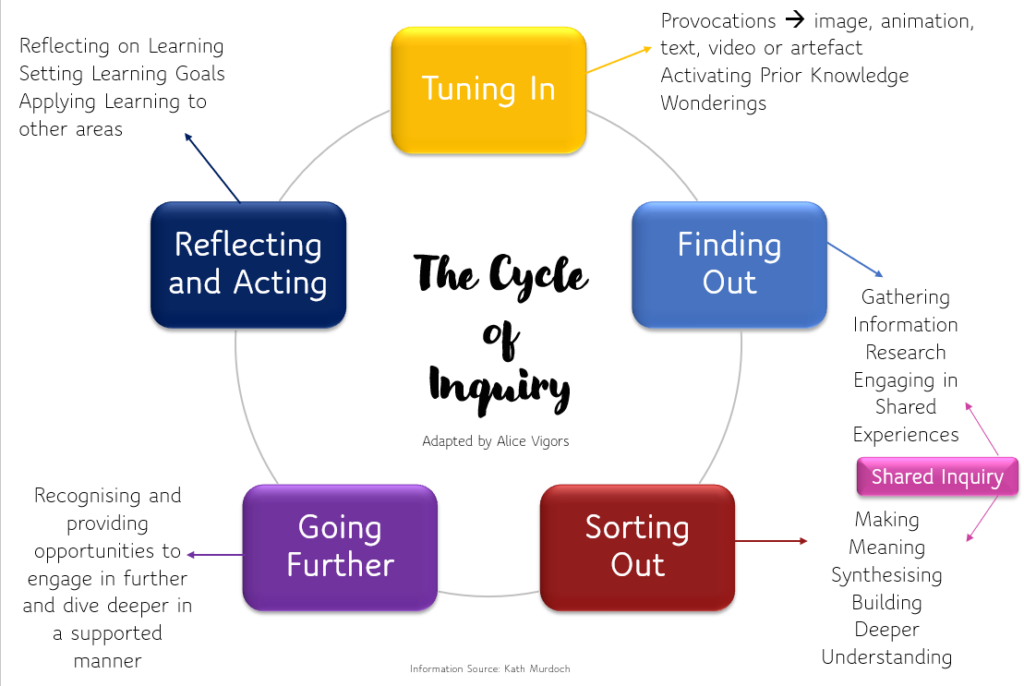
The inquiry visual displayed throughout OIA Primary classrooms is based on the work of renowned inquiry-learning expert Kath Murdoch and serves as a shared language for thinking, questioning, investigating and reflecting across the school.